My involvement with the radar installation on Bard Hill was over 50 years ago and I therefore cannot guarantee that my memories are completely reliable. There were two periods of my RAF career when I was connected with Bard Hill. The first was as a radar mechanic with the rank of AC2 and later I returned as a pilot officer when I worked as a radar supervisor.
We were part of RAF West Beckham and ‘Beckham Pylons’ will be remembered by many people in the neighbourhood. There were, I seem to remember, four of them with aerials suspended between and they were part of the earliest ‘echo location’ system in the country called ‘Chain Home’ or CH. Approaching aircraft would appear as a ‘spike’ on a straight line of a cathode ray tube and the range was simply ascertained by using the scale on the screen. The compass bearing was calculated using an electronic ‘goniometer’, an instrument for measuring angles, and the height of the aircraft was estimated by calculating its position within the radar ‘lobe’.
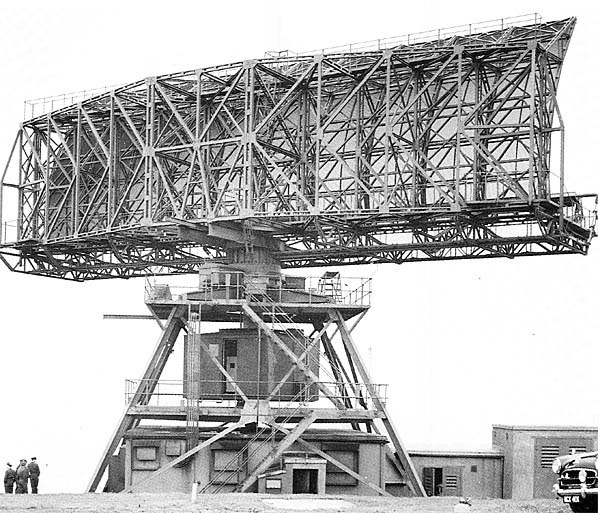
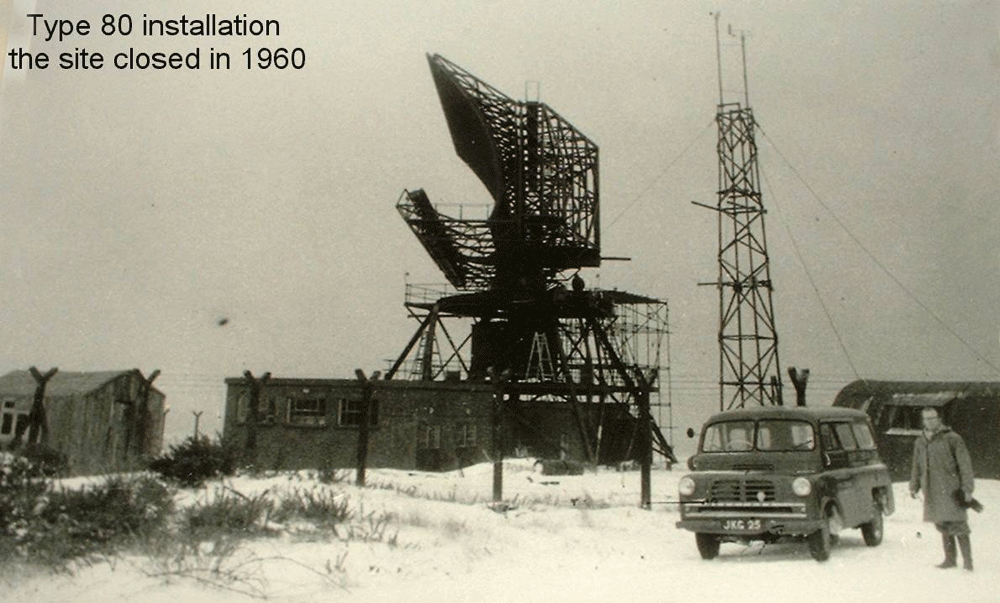
In the 1950s, Bard Hill, a few miles from the West Beckham aerials, was a ‘Chain Home Low’ or CHL station and was totally different, intended to detect aircraft which were approaching below the radar of the CH station. It consisted of a rectangular rotating aerial mounted on a blockhouse and resembled in many ways the radar aerials that are used by air traffic control at modern airports. The invention of the rotating aerial with its ‘pencil’ beam meant that CHL was an improvement on the earlier CH system in that it used a ‘Plan Position Indicator’, or PPI, which was a circular cathode ray tube with a cursor rotating in line with the aerial which would enable the exact position of the approaching aircraft to be plotted on a grid map printed on the screen. At Bard Hill, there was also a ‘nodding horror’, an aerial mounted on a trailer which moved in a vertical plane and was used to provide a more accurate height of any target aircraft.
None of this, however, could give a really precise position of any air traffic movement and information from Bard Hill together with all the other stations in the sector was sent to a Central Filter Plotting Centre, CFPC, where it was collated by a filter officer and he (or she) was responsible for deciding the actual position and height of the target aircraft. Even then, there must have been a large margin of error but the system had served us well as an early warning during the war and had enabled fighters to be scrambled in time to intercept the incoming enemy bombers. There was no ‘high tech’ involved in transmitting the information to the filter centre as it was simply done by the human voice, using a landline communication system, presumably scrambled for security, between the radar operator at Bard Hill sitting in front of the screen and the plotter at the centre, situated at RAF Neatishead which now has a Radar Museum.
Bard Hill was part of the Eastern Sector, 12 Group, Fighter Command, and was operational from dawn to dusk during the time I was connected with it (nobody asked the question as to what happened if an attack came in the hours of darkness). It meant that in the summer months the station started extremely early and duties were split into watches. Conditions were spartan. There was no accommodation block at Bard Hill and operators (including the supervisor!) were transported in RAF wagons from the domestic quarters, a hutted encampment at Bodham, close to Bodham church, at some distance from the village and in the fields. Heating was provided by coke-burning stoves and in the winter it was often bitterly cold. I used to tell friends that there was nothing but open sea between my billet and the North Pole. On one occasion the roads were blocked with snow and I can remember it reported that a local had explained the situation to a friend by stating, ‘Well yer see ‘bor; that blew ar’er that snew’. There were a few beds in the Bard Hill guard house, RAF issue beds, naturally, and these were used by the duty mechanics who had to be roused even earlier and ‘warm up’ the equipment in time for the dawn opening (this was in the days of thermionic valves, it must be remembered). The guard house was manned 24 hours by RAF Police, the famous ‘snowdrops’, on account of their white peaked caps. They were accompanied by Alsatian guard-dogs. Compared with today’s activity, there was little air traffic movement in those days and I can remember the competition to be the first to detect the early morning ‘milk run’, an aircraft which would fly daily between Schipol in the Netherlands and what was then a very small Heathrow airport.
Perhaps my most vivid memories are associated with the devastating floods of 1953. Bard Hill had closed for the night but I remember being with the Station Duty Officer in the Officers’ Mess at West Beckham and hearing the howling wind which was unlike anything I had ever heard before. We were not called out on the actual night of the devastation and had no real knowledge of the its extent until the morning BBC news service began, as it was before the days of 24 hours TV coverage, but in the ensuing weeks we provided manpower to help in shoring up the sea defences in the area.
Unfortunately, I have no photographs of my time at Bard Hill but it might be possible that there are some pictures of the station in its heyday to be found in the archives of the Radar Museum at Neatishead.